
|
Walkway Over Hudson Will Boost Tourism Say Experts |
|
|
|
|
Written by June Lamba-Lutwama, Hudson Valley Business Journal
|
|
April 02, 2009 |
|
Walkway Over the Hudson and Dutchess County Tourism held a Hudson Valley trails and economic workshop Tuesday aimed at raising awareness of the economic possibilities of the pending 7000-foot pedestrian bridge targeted for completion in September 2009, in time for the quadricentennial celebrations.
According to Fred Schaeffer, president of the non-profit Walk Over the Hudson, the workshop was organized to find ways of making the most of the project as a source of income for individual businesses and the area as a whole. " The Walkway Over the Hudson is creating what will be the world’s longest pedestrian bridge and will connect with trails on both sides of the river. We think it’s going to be an economic road to this area and that people will come from all over to visit and to enjoy the network that we have. So we invited a lot of tourist businesses to come to this meeting so that they can learn how to make the most of the walkway project when it opens this October," he said.
One of the keynote speakers , David Lindahl, a principal of Morton Trails, a sport and recreation trail systems consulting firm, said trails are now the most valued amenity for home buyers citing a study that showed that more people are retiring into rural and semi- metropolitan areas.
"Trails are now the most valued amenity that people consider when they buy a house , they are not just sort of a side piece but something that has become a part of people’s daily lives. They are valuing it for whether they are going out for run in the afternoon after work or simply vacations that are built around being around being able to mount bike or run or ski. So the economic benefits are very real, with about a 20,000 dollar premium for houses and lots that are proximate to a well designed trail system," he said.
The Walkway project estimated to cost $35 million, according to the Walkway website is expected to bring in 14 to 15 million dollars a year, said Rob Camoin, another guest speaker and principal at Camoin Associates, the firm which was hired to do a feasibility study and assessment of the project.
"The direct economic impact, that is additional spending from visitors, is estimated to be approximately 14 to 15 million dollars per year. These expenditures will result in a total of $21 million dollars of new economic activity regionally and statewide. That money that comes in from spending by visitors on goods and services that they wouldn’t have otherwise spent in Dutchess or Ulster county and it also includes the money that businesses take in ,"he said, adding that construction of the bridge would create 258 new jobs.
Camoin also added that the cost of the bridge, which spans the Hudson River and connects the City of Poughkeepsie in Dutchess County with the Town of Lloyd in Ulster County had gone up from 24 million dollars a year ago when the feasibility study was done, a hike Walkway attributes to increases in the prices of steel, concrete and fuel.
The workshop attracted a cross section of people in the tourism industry from Dutchess and Ulster counties and surrounding areas, according to Director of Dutchess Tourism, Mary Kay Vrba.
"There is a variety of people here, we have people from bed and breakfasts, hotels, art galleries, government, historic sites, restaurants, the trail users themselves and those that are responsible for the trails," she said. The workshop also featured other panelists who gave presentations on marketing strategies for trails in the area. |
|
|
The Mysteries of Nordic Trail Design Revealed |
|
|
|
|
Written by Bryce Evans, Summit Daily News, Summit County, Colorado
|
|
January 21, 2009 |
Trudging through on an old mining road, the Suburban began to slide sideways down the gravel path. John Morton and his wife clung, white-knuckled, to the sides of their seats, a little uneasy about their trip down Lincoln Meadows near the Sally Barber Trailhead.
“Don’t worry, we do this all the time,” the driver of the truck told him.
Morton rolled his eyes and laughed, recalling the “eventful” first look at the construction for the trail he designed at the Gold Run Nordic Center in Breckenridge.
Sitting at a table in Clint’s on Main Street Breck last weekend, Morton was relieved to be preparing for his next trip to his Hoodoo Voodoo Trail. This time, though, he’s trading the Chevy sled for some skis.
But before the renowned Nordic trail designer escaped for his day on the snow, he was stuck discussing his trade and sport to the uninformed local media — i.e. me. It’s not like he seemed upset about it, though. In fact, I’m pretty sure he could talk about Nordic skiing all day if he had the chance.
And what I was trying to figure out was how someone can stand on a hill overlooking a vast expanse of flumes, foliage and former mining roads and envision a top-of-the-line Nordic ski trail. That is to say, I wanted some secrets of the trade that Morton indirectly fell into a number of years ago.
First, a bit of background.
Morton, originally from New Hampshire, attended Middlebury College in Vermont, which was where he began his Nordic career. In his first team meeting for the Middlebury ski team, Morton sat surrounded by All-Americans and national champions.
“Our coach told us, ‘Look around. You can see that Alpine skiers are a dime a dozen on this team ... If you want to ski for Middlebury, you’d better concentrate on cross country,’” Morton recalled.
Morton went on to ski in two Winter Olympic games in the 1970s in biathlon. He later coached the U.S. team and served 11 years as the head coach of the Dartmouth Nordic ski team.
So, needless to say, his resume is pretty extensive.
He got into the design side of things after deciding he needed a change from coaching. Two friends of his envisioned a plan to turn northern parts of Maine into a Nordic hotbed. Their goal was to give a struggling area with a slumping economy a new source of revenue and tourism.
Morton designed 16 trails in the region, including two that have since served as sites for world championship competitions.
Now, the goal is to transform Summit County into one of the world’s top ski destinations, not just on the slopes, but through some of the flatter land.
“The downhill area does such a great job of bringing people into the community,” Jim Sanders, of the Gold Run Nordic Center, said, “So we thought, what can we do to bring people in and help the economy.”
One problem Morton saw with most mountain Nordic areas was the lack of technical terrain and overall versatility of trails.
“A lot of the skiing out here is on Forest Service roads and mining roads,” Morton said. “It’s a lot of long, gradual climbs and long, gradual descents.”
This is why Morton was brought in to design the Hoodoo Voodoo Trail, Sanders told me. “It’s not the size that matters, it’s having that diversity that brings people in.”
So Morton set out to create a trail that maximized the existing land in the Horseshoe Gulch but turned it into something that didn’t just follow the old paths already laid out.
He commuted to Breck five or six times during the design process, walking and hiking to get the feel for the land. He spent countless hours studying maps and plotting courses, trying to keep in mind the desires of the community that hired him.
Eventually, it came to the conclusion that you can see today.
Sanders probably best sums up how everything turned out.
“I started running it a lot this fall, and it was so cool,” he said. “I knew the design, had been on it, ran it, but once I got out on the finished product, I was like, ‘Wow, this is more than I could have imagined.’”
That’s how Morton decides whether his designs were a success or not. He simply leaves it up to the most important stakeholders: the skiers.
“ ... When they finish out the trail and they say, ‘Man, that was great, I’ve got to do that again,’ that’s what really matters,” he said. “If you get that response, then you’re doing it right.”
With the early praise the 5k trail is already receiving — including one man who, on my way out of Clint’s, told me it’s the best around — it looks like Morton did just what he wanted.
And for the area that was best known for finding that “yellow stuff,” it looks like it’s the “white stuff” that’s going to redefine Gold Run.
|
|
John Morton Recalls the 1976 Olympics and Discusses Trail Building |
|
|
|
|
Written by Peggy Shin, Team USA
|
|
January 15, 2009 |
In 1976, mainstream America was introduced to cross-country skiing when Bill Koch won a silver medal in the men's 30-kilometer race at the Innsbruck Winter Olympics. His feat astonished even his fellow Nordic skiers, who were probably some of the only Americans to witness it; no American journalists were at the Nordic venue that year.
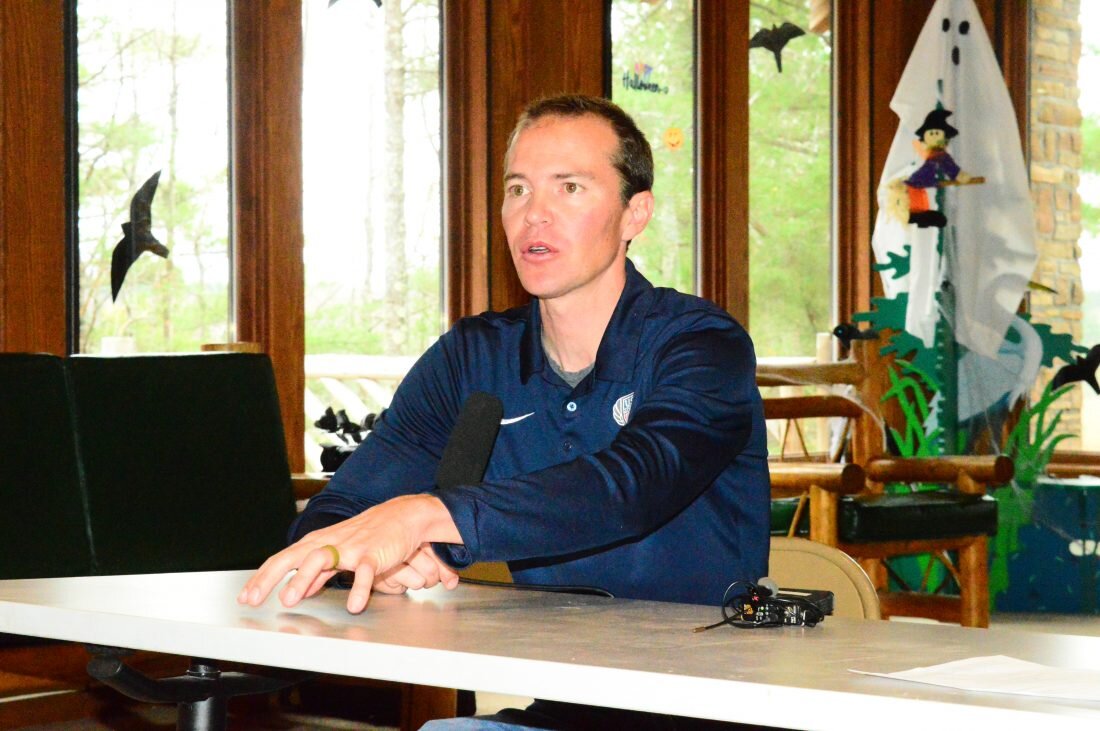
"I was there in the stadium," recalled Olympic biathlete John Morton, talking about his Olympic experience and his subsequent work building Nordic trails to a group of ski writers in Jackson, N.H., on January 10, 2009.
"We had just finished a biathlon workout, and somebody said, ‘Hey, the men's 30k is taking place right now, let's wander up through the stadium and see how it's going for the U.S. guys.'"
Morton and his teammates climbed into the stadium and looked at the electronic scoreboard. It listed Koch in second place. The 30km was an interval-start race (not head-to-head), with each competitor starting at a specified interval - for example, one minute - behind the next.
"We thought, ah well, he went out early and all the hot shots have yet to finish," said Morton. "But still having an American on the scoreboard at the Olympics was pretty good."
Soon, European athletes, spectators, and coaches began coming up to the biathletes, distinguished by their USA jackets, and saying, "Hey, Beel Koch, OK, U-S-ah, very good, U-S-ah, very good."
"We were thinking there must be something happening here," said Morton, "and sure enough as the race progressed and athletes would come in through the finish line, everyone would scroll down below second place, and it stayed. What a thrill to be there!"
The 1976 Winter Olympics were the second for Morton as a competitor (he also competed in biathlon in 1972). Since then, he has been involved with five more Winter Olympic Games as a coach, U.S. biathlon team leader, and most recently, as Chief of Course for the biathlon events at the 2002 Olympics in Salt Lake City.
For the past 20 years, he has also developed cross-country ski trails and through this work has had a direct impact on the development of future Olympians, like up-and-coming biathlete Russell Currier, 21, from Stockholm, Maine.
A decade ago, Morton helped re-establish Nordic skiing in Aroostook County, Maine's northern-most county where potato farming and timber are the primary industries. The goal, says Morton, was to make cross-country ski trails as accessible and as prevalent as Little League baseball diamonds in each community.
The program was highly successful, he says, with more than 5,000 kids participating in Nordic skiing in 72 communities. One of those kids was Currier, whose dad - a potato farmer - once described his young son in eighth grade as a couch potato. To this day, Currier lists napping as one of his favorite activities on his team bio.
"He had virtually no interest in athletics," said Morton. "In sixth grade, his recess activities consisted of snowball throwing and fighting with other kids."
But he tried Nordic skiing and "obviously had an aptitude for it," added Morton. Currier is a five-time Maine State Cross-Country Ski Champion, and in 2006, he added a national title to his trophy cabinet.
Currier also tried biathlon, and in 2004, qualified for the Junior Biathlon World Championships in France. In January 2008, he had three top-20 finishes at Junior Worlds, earning himself a World Cup berth this season.
"He's become a role model for the rest of the kids in northern Maine," said Morton.
The founder of Morton Trails, Morton continues his trail building work around the world, most recently redesigning trails at the Jackson Ski Touring Center to meet international racing standards. He lives in Thetford Center, Vermont, with his wife Kay.
Peggy Shinn is a freelance contributor for teamusa.org. This blog was not subject to the approval of the United States Olympic Committee or any National Governing Bodies.
|
|
N.H. Cross-Country Skiing Trails Get Upgrade |
|
|
|
|
Written by Peggy Shinn, Boston Globe
|
|
January 14, 2009 |
 The Jackson Ski Touring Foundation in Jackson, N.H., recently redesigned a few trails to meet race standards set by the International Ski Federation (FIS). While most cross-country skiers don’t care whether or not the national championships or Junior Olympics come to town, the redesign does have benefits for recreational skiers. The redesigned trails are now wider — almost 30 feet wide on one loop, which means you and three friends can ski side-by-side. And these trails don’t go up, up, up, then down, down, down. “There’s nothing worse than having to work to get up some long hill and then have some long boring descent,” said former Olympic biathlete and coach John Morton, who helped Jackson Ski Touring Foundation executive director Thom Perkins redesign the trails. Morton is the founder of Morton Trails in Thetford Center, Vt., and was in Jackson on Jan. 9-10 speaking at a ski writers’ meeting.
On the redesigned five-kilometer loop, which leaves from the fields below the Eagle Mountain House in Jackson, a short but stiff climb on the Christmas Tree Farm trail — with one whoop-dee-do downhill — took me to a trail named simply John, named after a local landowner. John rolls through an open pasture with views of snow-frosted Mt. Washington, then climbs and descends gently through a pine forest. The Wave and Henry, named after John’s brother, climb deeper into the forest. But only near the top of Henry did I wonder where the top was. “You make the climbs subtle so people don’t really have a sense of how much they’re climbing,” said Morton. “And you make the descents worth it.” The Wave back to the Eagle Mountain fields descends like a mini roller coaster through the woods — “one of the most enjoyable descents on cross-country skis anywhere in the northeast; it’s pure, simple fun” is how Morton describes it. Wide, smooth, curvy, and rolling, it was worth every huff and puff up Henry. The Wave was originally cut in 1988, but Morton and Perkins knew they had to keep its descent as part of the redesign because it fit with Morton’s trail-design philosophy: “to make the downhill enough fun so that people will want to do it again, even though they know they’re going to have to climb to get back up there.” And that’s exactly what I did.
|
|
Stephen, Chamberlain Headline TD Banknorth Eastern Cup Opener |
|
|
|
|
Written by Faster Skier/NENSA
|
|
December 19, 2008 |
Stowe, VT—Trapp Family Lodge plays hosts to this year’s TD Banknorth Eastern Cup opening weekend. The Eastern Cup begins its fourteenth year as NENSA’s signature race series and this weekend will feature several of the nation’s best cross-country skiers. The Trapp Touring Center has been blessed with early season snow and the snow cover has been enhanced with their expansive snowmaking system. Saturday’s one kilometer classic technique sprint race and Sunday’s five and ten kilometer freestyle technique races will utilize the center’s new John Morton designed race courses. The events serve as New England Junior Olympic Team Qualifiers and will be scored to the USSA National Ranking List.
East Montpelier, Vermont’s Liz Stephen is the event’s headliner. A Burke Mountain Academy graduate, Liz is coming off a 3rd place finish at last year’s World U23 Championships. She and her US Ski Team coach Matt Whitcomb will give a one-hour coaches’ clinic at the conclusion of Sunday’s race open to all coaches for no charge. Liz, however, will not be unchallenged; 2008 World Junior Team qualifiers and Dartmouth College skiers Ida Sargent and 2008 Eastern Cup Champion Sophie Caldwell, UVM’s Jennie Bender and a group of quickly rising New England junior and collegiate skiers will be doing their best to chase her down.
On the men’s side, it will be a battle of youth versus experience. Masters skier New Hampton, New Hampshire’s Justin Freeman is a former Olympian and fellow Master David Chamberlain is a 3-time World Championship team member. Eli Enman should also find himself in the chase on both days. UVM’s Juergen Uhl, a 2008 NCAA All-American, should prove tough on the course, and last year’s TD Banknorth Eastern Cup Champion and Colby College skier Matt Briggs should not be counted out. Youngsters Kevin Cutts and UVM’s Alex Howe have proven to be very tough on the sprint course and should be top qualifiers in Saturday’s sprint.
One great feature of the Eastern Cup is that it is not just for the very fastest cross-country ski racers. Athletes of all speeds get to compete side-by-side with some of the nation’s best, there is masters seed group that allows those over thirty to race together, and for the first time in NENSA’s history, Saturday’s sprints will feature the “Cupcake Sprints.” NENSA Youth and Intro Programs Director Abby Weissman has baked cupcakes to be handed out to the winners (and maybe the losers too) of the informal head-to-head races at the conclusion of the official finals. Also new this year, in order to promote a more environmentally-friendly community, NENSA has joined Terracycle’s Wrapper Brigade. In mid-2008, Terracycle launched the Wrapper Brigade, a project that finally puts use to the millions of energy bar wrappers that were formerly discarded. Since its initiation, the program, which is sponsored by Clif Bar, has collected over 300,000 wrappers, which have been turned into products ranging from tote bags to notebook covers. At all of NENSA’s major events this season, bring your empty bar wrappers and look for the recycling boxes under the TD Banknorth tent.
Please note that day of race registration is available for both day's races. |
|
|